

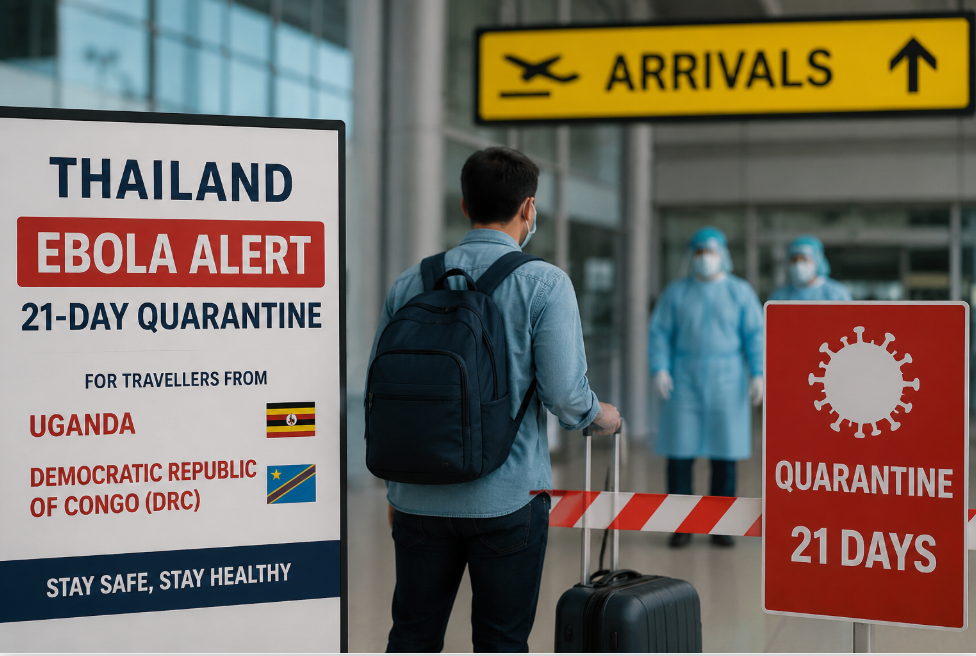
Thailand has introduced mandatory 21-day quarantine measures for travellers arriving from Uganda and the Democratic Republic of the Congo following concerns over the spread of Ebola Virus Disease (EVD) in the region.
The new restrictions, approved by Thailand’s National Communicable Disease Committee, will officially take effect at 6:00 pm on May 27, 2026, as part of efforts to prevent the virus from entering the country.

The decision comes amid increasing international concern over the latest Ebola outbreak in the DRC. The World Health Organisation recently classified the outbreak as a Public Health Emergency of International Concern (PHEIC), the organisation’s highest global health alert level.

According to WHO statistics, the DRC has reported 867 suspected Ebola cases and 214 deaths linked to the outbreak, while Uganda has so far recorded five confirmed cases and one death. Ugandan health authorities have since intensified surveillance, contact tracing, public awareness campaigns, and screening at border points and airports to contain the virus.
Dr Montien Kanasawadse, Director-General of Thailand’s Department of Disease Control, said the government had strengthened border surveillance and public health measures in response to the Bundibugyo strain of Ebola currently circulating in parts of Africa.

Thailand’s Ministry of Public Health has now categorized Uganda and the DRC as dangerous communicable disease zones under the country’s Communicable Diseases Act, allowing authorities to enforce strict health controls on incoming travellers.
Under the new rules, anyone arriving from or transiting through Uganda and the DRC will be required to undergo mandatory quarantine or isolation for at least 21 days, which corresponds to the maximum incubation period of the Ebola virus.
Travellers who do not display symptoms will be quarantined at government-designated facilities, while those showing signs of illness will immediately be isolated and transferred to approved medical centres for further examination and treatment.
Thailand remains a popular destination for Ugandan traders, businesspeople, tourists, and patients seeking medical treatment, especially those involved in importing electronics, textiles, cosmetics, machinery, and household goods from Bangkok and other commercial hubs.
The restrictions are expected to affect travel and business operations for many Ugandans who frequently travel to Thailand for trade, education, tourism, and healthcare services.
Although Thailand has not reported any Ebola cases, authorities say the seriousness of the disease and growing travel links between Africa and Asia have made stronger preventive measures necessary.
Thai officials also warned that anyone who violates quarantine or isolation rules will face penalties under the Communicable Diseases Act of 2015. Individuals refusing quarantine orders could be fined up to 20,000 baht, while those escaping from quarantine facilities risk imprisonment for up to one year, fines of up to 100,000 baht, or both.
The latest measures add to a growing number of international travel restrictions and health surveillance efforts targeting countries affected by Ebola outbreaks in East and Central Africa.